
#2 The Non-Linear Career. Why the Future Belongs to People Who Can Connect the Dots
Beata Magdziarz
The second article in the series „Career Architecture in Practice.” This time, not about what to do. About how to think.
In this article, you will learn:
• why the era of single-use competencies is drawing to a close, and what that means for your career
• what intellectualism as a professional habit is, and why it is becoming one of the most underrated assets in the labour market
• why creativity is no longer the domain of artists and is becoming a strategic competency in every role
• what distinguishes a non-linear career from the absence of a plan, and what the capacity for synthesis looks like in practice
• how to approach professional experimentation depending on the career stage you are at
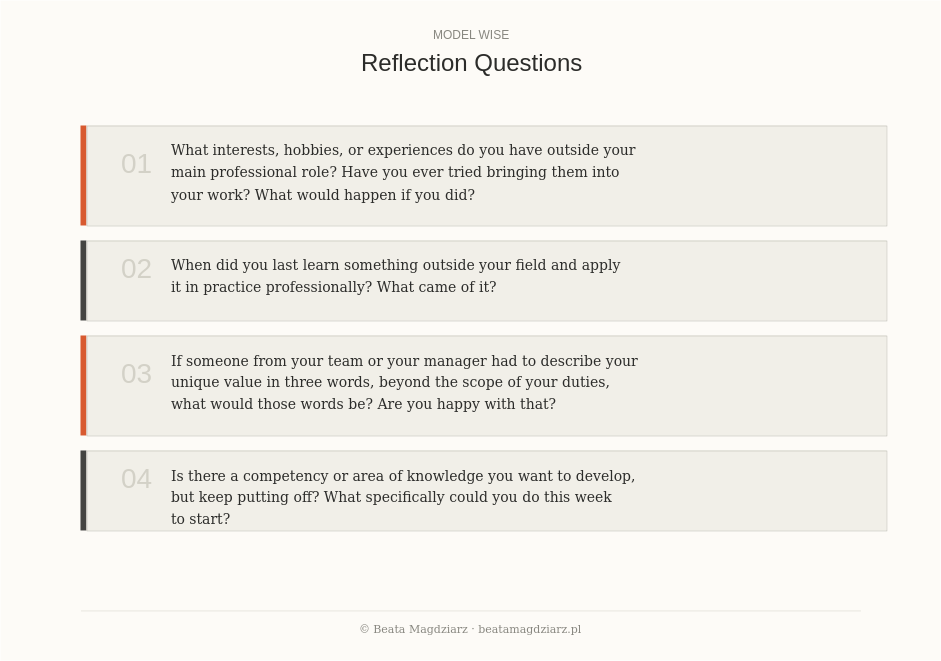
• at the end of the article, you will find reflection questions and additional resources to inspire action
A few weeks ago I published a piece about future competencies. It wasn’t another article arguing that everyone should learn to code, master prompt engineering, or pick up the latest AI tool. I was trying to show something deeper: that future competencies are, above all, about how you think, how you learn, and how you build relationships. That the WISE model isn’t a to-do list to tick off, but a career architecture that demands conscious management across all four dimensions simultaneously.
Since then, one question keeps coming back to me. What actually underpins those seven competencies? Why do some people develop them relatively naturally, while others, despite access to the same reports, courses, and tools, find it enormously difficult? The longer I sit with that question, the more convinced I become that the answer doesn’t lie in another methodology or certificate.
It lies much deeper. In the way you look at the world.
The era of single-use competencies is drawing to a close.
For the past two decades, the labour market has rewarded specialisation. The logic was simple: the more you know about a narrower slice of reality, the more value you can deliver. That approach worked brilliantly for years, because expert knowledge was relatively durable and change happened more slowly than it does today.
But we are living in a moment of historical acceleration. According to the World Economic Forum, around 39% of key competencies required in the labour market will change by 2030. Artificial intelligence can already prepare a report, analyse vast datasets, generate code, and propose a marketing strategy in time that would have been unattainable for a human just a few years ago. That doesn’t mean the end of human work. It does mean the end of the comfortable belief that knowledge acquired once will be sufficient to secure a career for the next several decades.
Interestingly, data from Coursera’s Job Skills Report 2026, based on information from over six million learners across nearly seven thousand organisations worldwide, points to something worth paying close attention to. The fastest-growing competency across all groups surveyed is critical thinking, with year-on-year enrolment growth exceeding 100% in every category; among those developing GenAI competencies, that growth reaches 185%. Research by Lightcast, analysing job postings requiring AI skills, found that 8 of the 10 most frequently required capabilities are human: communication, problem-solving, leadership. Not technology. Simply possessing answers is becoming less and less valuable. The ability to ask the right questions is becoming more and more important.
The return of intellectualism.
There is one trend I consider among the most underappreciated in conversations about the future of the labour market. It is the return of intellectualism, understood not as academic erudition, but as a deep, practical curiosity about the world. The ability to understand the dependencies between phenomena that appear, on the surface, to have nothing to do with one another.
For years, business was fascinated by productivity, efficiency, and optimisation. Today it is increasingly clear that the most significant breakthroughs emerge at the intersection of different disciplines. Between technology and psychology. Between economics and culture. Between biology and design. Between art and business. The most interesting innovations of recent years didn’t happen because someone knew more than everyone else in their own domain. They happened because someone was able to connect knowledge from different worlds and give it a new meaning.
Intellectualism in this sense is not a character trait or a level of education. It is a habit. The habit of asking questions before formulating answers, of seeking causes rather than just effects, of understanding context rather than merely facts. In the WISE model I described in my previous article, this attitude permeates all four tracks simultaneously: it changes the way you do your work, builds deeper professional self-awareness, strengthens a visibility grounded in real value, and allows you to lead others with greater reflection.
Creativity as a strategic competency.
For a long time, creativity was treated as a talent reserved for artists, designers, and advertising creatives. That framing is becoming obsolete, and in a very literal sense.
The WEF’s Future of Jobs Report 2025 lists creative thinking as one of the five key competencies of 2025 and as one of the fastest-growing in significance through 2030. Not because the world has suddenly started appreciating artists. Because in an economy driven by artificial intelligence, creativity is becoming a strategic competency in every profession. As algorithms become increasingly adept at analysis and the execution of repetitive tasks, human value shifts toward what machines still cannot do with equal effectiveness: creating meaning, building context, understanding human motivations, and imagining realities that don’t yet exist.
Creativity in this sense is not an absence of structure, nor is it improvisation. It is the ability to see connections between things that appear to have nothing to do with each other. It is the courage to propose an interpretation others haven’t seen yet. It is the skill of building new meaning from available material. And that is precisely why it is so closely intertwined with intellectualism: one without the other produces either curiosity without direction, or ingenuity without depth.
From specialisation to synthesis.
I find myself increasingly convinced that the future won’t belong to narrow specialists, nor to generalists without roots. It will belong to people capable of synthesis, those who can move between different areas of knowledge and experience and build bridges that others haven’t yet seen.
In a world shaped by artificial intelligence, a career will increasingly resemble not a single ladder to climb, but a mosaic built from different roles, projects, and professional identities. Consultant and mentor. Strategist and maker. Technology expert and educator. Business leader and artist. Data from the Polish market confirms this: 71% of specialists and managers are upskilling independently today, and almost half feel the chaos brought on by the pace of change. That chaos won’t disappear with another certificate. It will disappear when people learn to connect knowledge from different fields into their own coherent model.
Looking at my own professional path, I see this far more clearly today than I ever did before. Sport, digital, technology, artificial intelligence, mentoring, education, leadership, art. For years I treated these as separate chapters, wondering whether I should choose one path and one specialisation. Today I see they were elements of a single story, and that it is precisely their diversity that became the source of what I bring to conversations with leaders, teams, and organisations. Not because I know more than a specialist in any one field. Because I can see dependencies that a single-field specialist cannot.
Perhaps that is what lies at the heart of a non-linear career. Not the absence of a plan, but the courage to connect things others haven’t yet tried to connect. The understanding that what looks today like a detour from the route may, in a few years, turn out to be the most important element of the entire story.
What is worth investing time and energy into depends on the career stage you are at. When you are starting out, experimentation is absolutely essential, because you don’t yet know what genuinely engages you, or where your energy translates into results. Try things. Step into new projects. Accept invitations into environments different from your own. The fear of wasting time on something that may not become your main path is one of the biggest mistakes at this stage. Every experience is a dot you will connect later.
When you are halfway through your career, experimentation still has value, but it demands a different kind of maturity. The question is no longer what do I want to try, but what specifically can this give me and where does it lead. Intentional experimentation isn’t a chaotic change of direction. It is a strategic expansion of your competency stack, which I wrote about in my previous article: a deliberate construction of a combination that creates something unique.
In the world that is coming, the advantage will belong not to those who perfectly executed one scenario their entire life, but to those who had enough curiosity to experiment, enough courage to draw conclusions, and enough reflection to connect the dots into their own, irreplicable pattern.
Additional Resources
To watch and explore:
- reMarkable, The experimental mindset: a faster way to learn and grow | Neuroscientist Dr. Anne-Laure Le Cunff (From Beata: on replacing the frustrating pursuit of linear goals with an experimental mindset that transforms the need for control into curiosity. Treating challenges as scientific experiments allows you to find solutions faster and reduce the anxiety that comes with working in an unpredictable world. Through practical methods like autoanthropology and short pacts, you learn to draw conclusions and build a more innovative approach to daily responsibilities)
- Big Think, A Harvard career coach’s “unspoken rules” for getting promoted | Gorick Ng for Big Think+ (From Beata: presents a simple but effective method for taking ownership of tasks by articulating four things every time: why, what, how, and by when. It helps you be heard, remembered, and builds better relationships)
- Harvard Business Review, Identity Crisis: Why Defining Yourself by Your Career Is a Problem [YouTube] (From Beata: an interesting concept, the Maranasati Death Meditation, for viewing your professional path from a different perspective, normalising anxiety, and assessing what is transient and what endures)
- Oprah, What is Your Full Potential with Adam Grant and Oprah (From Beata: on the idea that a person’s true potential is measured by the distance they have travelled, not the point at which they started)
A book worth reaching for:
- Rick Rubin, The Creative Act: A Way of Being (2023). (From Beata: Rick Rubin spent decades producing music for artists as different as Johnny Cash, the Beastie Boys, Red Hot Chili Peppers, and Adele. He wrote a book not about how to create, but about how to be a person who is capable of creating. And that is precisely what makes it exceptional among all the creativity guides out there. Rubin argues that creativity is not a talent or an artist’s privilege. It is a way of looking at the world, available to anyone who is attentive enough and open enough to notice what others don’t see. For me, this is a book about something rarely discussed in the context of careers: the greatest things don’t emerge from perfect mastery of craft, but from the courage to look differently. Which is exactly why I recommend it to everyone who thinks creativity isn’t their subject.)