
#1 Future Competencies: What They Really Mean and Why Most People Get Them Wrong
Beata Magdziarz
In this article, you will learn:
• why most job interviews fail for both sides
• what future competencies actually mean according to major market research reports, and what that means in practice
• which 7 competencies I consider essential, and how to understand them at different career stages
• what the WISE Model and the Four Tracks of Career Architecture are, and how to use them to plan your development
• what you can do today, whether you’re just starting out, halfway through your career, or already managing a team
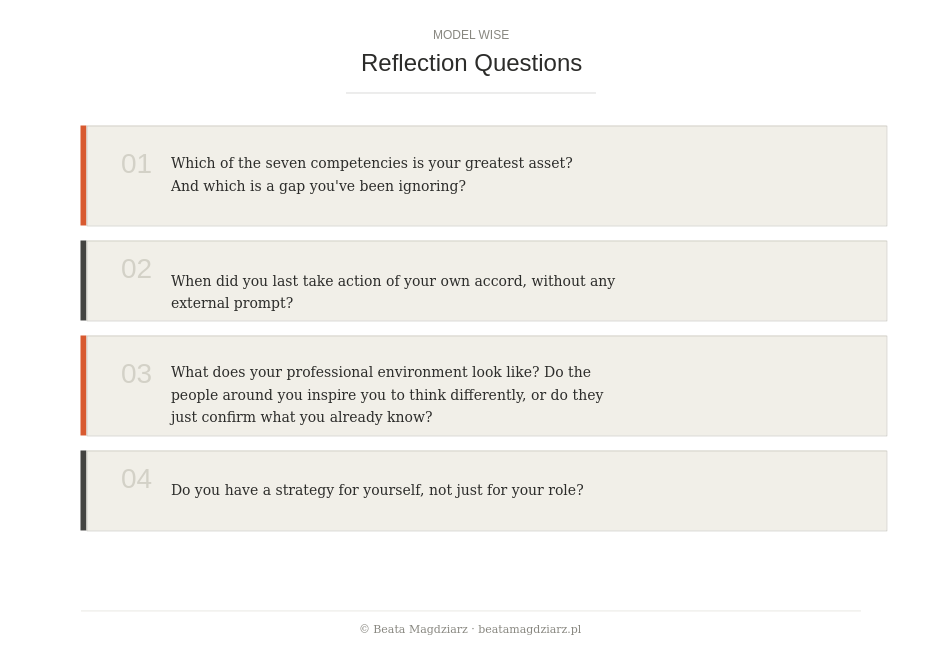
• at the end of the article, you’ll find reflection questions and additional resources to inspire action
For years, I conducted recruitment interviews and watched the same pattern play out from both sides of the table. A pattern that first irritated me, then intrigued me, and eventually became one of the most useful diagnostic tools I know.
The candidate walks in confident. They know their CV. They speak fluently about what they’ve done. But when I ask why they want to work here specifically, I hear something about a passion for the industry and a dynamic environment. When I ask what value they’ll bring to this particular role, I get a description of their interests. And when, at the end of the conversation, I ask if they have any questions for me, they ask about the number of remote days or parking. These aren’t bad questions. But the person asking them first leaves the interviewer without an answer to the only question that truly matters: do I want to work with this person? These are questions that tell me one thing: this person came prepared for an interview, not prepared to have a conversation.
There’s something deeper here than a lack of knowledge about the company. And it’s not that asking about remote working days is wrong. It’s about the order. A candidate who leads with conditions rather than value is unconsciously signalling something very specific: I’m not thinking about what I can give this business. I’m thinking about what this business can give me. A subtle difference but absolutely legible to the person on the other side of the table.
It’s an absence of architecture a way of thinking about yourself as someone who brings specific value to a specific system. Candidates often arrive with high self-confidence and clear expectations of the employer. But confidence is not the same as self-awareness. It’s hard to build a narrative about yourself that goes beyond a list of things you like doing, when nobody ever showed you how. It’s hard to sense the difference between knowing your talents and knowing your preferences. And rarely does anyone teach us how to step into the shoes of the person across the table to move through that one-hour conversation with intention and purpose, rather than improvising answer after answer.
The other side of the table is equally interesting. A hiring manager often loses track of time, has no interview plan, asks a little about everything rather than consciously guiding that hour toward a specific goal. They don’t think deeply enough about what they’re actually looking for in business terms: what competency gap this person is meant to fill, what problem they’re meant to solve, what result they’re meant to generate. Meanwhile, the candidate on the other side recounts dozens of situations from their past, rather than presenting three key ones with clear outcomes – context, action, result. Strategic questions, like what success looks like in this role after six months, or what the most pressing challenges are, are rarely asked by either party.
An interview hour is an interview hour, for both sides. The interviewer has it to know, when the candidate leaves the room, whether this is the right person. The candidate has it to ensure they remain in the interviewer’s mind as someone they want to hire. Nobody guarantees the conversation will naturally go in the right direction. If a candidate’s goal is to get the job, the question isn’t: what will I say when they ask about my experience. The question is: what’s my plan for these 60 minutes to leave the interviewer thinking of me as someone they want to hire? Waiting for questions and preparing two success stories isn’t enough. That’s participating in a conversation, not leading one. Each side has the same amount of time and each side can use it strategically, with a clear architecture for what they want to convey and in what order. Interviews where both sides understand this are entirely different from those where neither has a plan.
And then the same disconnect carries over into daily work. It’s easy to sink into responsibilities and treat their execution as the only measure of your contribution. Looking at your work on two levels what you do today, and who you are professionally beyond your job description: what talents and potential you hold, whether you’re visible, how you’re perceived by your manager and by senior leadership — that’s a skill that has to be learned. Just like the candidate at an interview who rarely realises they’re also responsible for how it goes. It’s their project, not just their test. They can design it, give it direction, and leave with something more than a date for the hiring decision. Managers run operations, but rarely have a strategy for themselves in the way they have a strategy for a project. We associate strategy with company strategy. But what about a strategy for yourself?
Each of us functions professionally on several levels at once. There’s the daily work and its results. There’s who we are professionally beyond our job title. There’s our visibility inside the organisation and in the market. And there’s how we lead others, if we have that privilege and responsibility. These four dimensions don’t compete with each other — they operate in parallel. The problem is that most people consciously manage only the first. Not because they don’t want to. Simply because nobody named it before, and nobody showed them how.
Over years of working with people at different career stages, I developed my own framework. I call it the WISE Model – the Four Tracks of Career Architecture. It’s a practical concept that helps you consciously place your competencies and plan their development strategically, not reactively. Each track is a separate arena where you’re playing simultaneously though in different proportions, depending on your career stage:
W — Work: my daily work, responsibilities, projects, results, and the competencies I build along the way
I — Identity: who I am professionally beyond my job description – my talents, values, and potential
S — Stand Out: my personal brand – how I’m perceived by my manager, senior leadership, and the market
E — Empower: how I develop others, how I motivate, what kind of leader I am
Each of these tracks can have a strategy. And it’s worth having one.
The biggest project of your professional life has no name, no budget, and no timeline. It’s called your career. Why do we so rarely manage it? It’s not a question of bad intentions or laziness. It’s a question of the fact that nobody teaches this. And that’s exactly what this series is about.
In the following sections of this article, you’ll find:
- what market research reports say, and what to pay attention to regarding future competencies
- the 7 future competencies I consider essential, and how they fit into the WISE model
- how to build your own WISE model
- which competencies matter in each track, and how to develop them at different career stages whether you’re just starting out, halfway through, or already managing a team
This article is part of the series „Career Architecture in Practice.” All articles can be found in the Blog / Inspiration section.
The market is changing faster than our approach to development. What the data says and how to read it.
Reports on future competencies are one of the best available knowledge bases for understanding where the labour market is heading. They’re worth knowing. Worth drawing on. As long as you read them as signposts, not instruction manuals.
The World Economic Forum’s Future of Jobs Report 2025 analysed the outlook of over a thousand global employers representing more than 14 million workers across 55 economies. The scale of that study is remarkable, and the findings are concrete. By 2030, around 39% of key competencies required in the labour market will have changed. 170 million new jobs will be created; 92 million will disappear, a net gain of 78 million positions. That’s an optimistic macro picture. But a global number says nothing about who specifically will fill those roles.
Among the competencies most valued today, the report identifies analytical thinking as number one – 7 in 10 employers consider it absolutely essential. Close behind are adaptability and resilience, leadership and social influence, and creative thinking and self-awareness. Notably, half of the top 5 are soft competencies, not technical ones. In the fastest-growing skills category through 2030, the WEF puts AI and big data first, ahead of cybersecurity and technological literacy with creative thinking, resilience, curiosity, and lifelong learning right behind.
Coursera’s Job Skills Report 2026, based on data from six million learners across nearly 7,000 organisations worldwide, reveals something striking. The fastest-growing competency across all groups is critical thinking with year-on-year enrolment growth exceeding 100% in every category studied. In the GenAI category, growth reached 185%. Lightcast, analysing job postings requiring AI skills, found that 8 of the top 10 required competencies are human: communication, problem-solving, leadership. Not technology. That’s a signal worth remembering.
The ILO’s Employment and Social Trends 2026 adds a perspective that rarely makes headlines. AI adoption is beginning to pose a particular risk to skilled young workers entering the market — those who had been counting on entry-level roles in knowledge-intensive sectors. At the same time, the global employment gap will reach 408 million people in 2026, which shows that the problem isn’t a lack of jobs it’s a mismatch of competencies on both sides.
From my perspective: this isn’t the end of entry-level roles. It’s the end of entry-level roles without competencies. Someone who, before their first job, actively engages in projects, consciously builds skills, and gains experience, enters the market in a fundamentally different way than previous generations. They can build a position as an AI specialist or LLM analyst at a pace that was previously unattainable. The path is open but it requires an entirely different approach to self-development than ever before. More investment in competencies, courses, experience, and networking. And contrary to appearances, prompting is just the tip of the iceberg. The real advantage runs deeper: in soft competencies, in critical thinking, in the ability to ask the right questions, in the capacity to collaborate with technology rather than merely operate it.
Interestingly, this shift doesn’t only affect people entering the market. Those entering the AI era have it somewhat easier, because technology adoption comes naturally to them. The real challenge lies in the mindset shift for workers with years of experience. Stepping out of entrenched habits and proven methods is far harder than learning new competencies. Today’s reality demands working differently than before: seeking new solutions, experimenting, leveraging technology. And in my experience, the hardest part of that change isn’t the technique. The hardest part is letting go of what used to work.
The Hays and OFF school Foundation study from 2025, conducted among nearly 200 Generation Z workers and over 100 employers from older generations, brings data from the front line of the Polish labour market. 38% of managers state outright that Gen Z workers don’t demonstrate the attitudes they’d expect from employees: independence, transparent communication, proactivity, knowledge sharing. At the same time, 80% of Gen Z respondents rate their own engagement as high or very high. This discrepancy isn’t a matter of dishonesty on either side. It’s a matter of the absence of a shared language and of expectations that nobody has named clearly.
All of this data builds a coherent picture. Reports point the direction and provide a solid foundation for understanding change. What I look for in my work with people is the connection between those trends and practice what these competencies mean not as research categories, but as things to do on a Monday morning, in a specific role, at a specific career stage.
What future competencies are not.
Before I get to what they are, let me say a few words about what they’re not. Because a lot of noise has accumulated in this space.
Future competencies are not a list of courses to complete. LinkedIn Learning, Coursera, prompt engineering certifications, these are tools that can support development. But a communication course won’t teach you to listen with genuine curiosity. A project management certificate won’t give you the habit of thinking about what value your work delivers to the system. Formal knowledge is a starting point, not a destination.
Future competencies are also not a matter of personality. I often hear: „but I’m an introvert” or „I’m not the leadership type.” An introvert can be visible in an organisation, not by speaking on a stage, but by the value they give others. You can be a leader without a title, without a team, without a budget. It’s a question of attitude, not position.
And finally: future competencies are not a topic only for those just starting out. Perhaps even more so for those halfway through their careers who think they already know what they’re doing. Competency stagnation is particularly dangerous in people with a decade or more of experience, because it generates a false sense of security.
Three pillars. A framework that clears the chaos.
Over years of observation in recruitment, mentoring, and management, I developed my own way of looking at professional competencies. Not as a list of things to master, but as three fundamental questions that each of us must be able to answer at any point in our career.
How you think. How you process information, how you make decisions with incomplete data, how you connect knowledge from different domains, how you manage your own learning process.
How you act. How you initiate, how you take ownership, how you communicate your intentions and results to people and to systems (including AI systems), how you present yourself and your ideas.
How you connect with others. How you build relationships, how you understand another person’s perspective, how you consciously design your professional environment.
These three pillars aren’t original as a philosophy, every competency model references them in some way. The value of a framework lies not in its uniqueness, but in the fact that it organises thinking. When I look at a candidate, a manager, a leader, I always ask: in which of these three areas is there the greatest room for development? And the answer is usually predictable. People early in their careers rarely struggle with acting, more often with systemic thinking and building relationships based on genuine mutual understanding. Mid-level managers typically connect well with others, but agency and strategic thinking take a back seat. Senior leaders and executives often stop learning, because after years of developing competencies deeply in one domain, being a beginner becomes an increasingly rare experience.
None of these areas works in isolation. You can think analytically and be completely unable to communicate it. You can understand others perfectly and still not act, waiting for external prompts. The framework only makes sense as a whole.
7 competencies that genuinely shift your professional position. My list, and why these specifically.
What follows are my seven future competencies. This is not a summary of WEF reports. It’s an interpretation grounded in data, but above all in what I see in real life: in conversations, in teams, in mentoring processes. Each competency is rooted in one of the three pillars.
Pillar I: How You Think
1. Strategic thinking under uncertainty
The WEF consistently identifies analytical thinking as the number-one competency. I agree but I want to be precise about what we’re actually talking about. Analysis is a tool. Strategic thinking is the ability to act on the basis of analysis, particularly when data is incomplete, when assumptions shift, when there’s no single right answer.
In practice, it looks like this: most people I encounter can gather and organise information. Very few can say: „I have 60% of the data I need. I’m making a decision. Here are my assumptions, and here’s the risk.” That’s the difference between an analyst and a strategist and it has nothing to do with job title.
For a student: start by asking „why” instead of „how.” Don’t ask how to do something. Ask what the point of doing it is, and what happens if you don’t. For a manager: do your decisions stem from strategy, or from reacting to whatever’s happening right now? Can you defend your plan against the question „what if you’re wrong”?
2. Combining competencies into stacks (skill stacking)
Strategic thinking isn’t a single skill. It’s a way of seeing the world that combines data analysis, contextual understanding, consequence mapping, and the courage to choose. Together, they form a stack. And it’s in terms of stacks that it’s worth thinking about your competency development. We learn in stacks, not individual skills. Consciously choosing which stack to develop is one of the more important professional decisions we can make.
Rather than learning an entire skill at once, identify its key components, the most important sub-skills and the elements with the greatest leverage. Instead of „learn to present” as a single goal, break it down into: argument structure, storytelling, body language, and pacing. Each can be practised separately and deliberately.
Peter Hollins, in The Science of Rapid Skill Acquisition, describes a concept he calls skill stacking. His central argument: instead of becoming the best at one thing, you build unique value by combining several competencies that together create something nobody else has. Marketing and data. Technology and strategy. Psychology and communication. This is precisely the career model of the future.
The first step in building a stack is deconstruction, breaking each competency down into micro-elements: its core components, most important sub-skills, and highest-leverage elements. Instead of „learn to present” as a single broad goal, you break it into: argument structure, storytelling, body language, pacing. Each can be practised separately and deliberately.
In practice, this means consciously choosing the stack you want to build. You don’t learn randomly, based on whatever happens to be available. You decide what combinations of competencies make sense for your path, and build them intentionally. Every stack you master becomes a foundation for building the next one faster. It’s a snowball: the more stacks you have, the easier it is to learn new things, because you increasingly connect dots between what you already know. And it’s precisely these stacks, the ability to combine business context, communication, data, and strategy that become a natural foundation for working with AI. Those who understand the system create solutions with AI. Those who don’t just use it.
3. Learning as a competency (meta-learning)
The WEF lists curiosity and lifelong learning as one of the most rapidly growing competencies. What does that mean in practice? Curiosity is an attitude. Meta-learning is a skill. It’s about consciously managing your own process of acquiring new knowledge.
Hollins describes four stages of rapid competency acquisition that are worth knowing regardless of what you’re learning. The first is deconstruction which I covered in the previous point: breaking a skill into micro-elements and focusing on those with the greatest impact. The second is deliberate practice focused exclusively on the most important elements, in short sessions with a specific goal. Hollins draws here on Anders Ericsson’s concept of deliberate practice: it’s not about time spent, but about the quality and intentionality of each session. The third stage is the feedback loop — a mentor, recording yourself, analysing errors, rapid feedback. This is the stage most often skipped, and without it, learning slows dramatically. The fourth is iteration: practise, correct, try again, repeated until the competency no longer requires conscious effort and becomes part of how you operate.
Hollins synthesises several key theories in this method: Ericsson’s deliberate practice, chunking from cognitive psychology, spaced repetition from memory research, and feedback loops from learning theory. Together they form a system that dramatically shortens the time needed to master a new competency.
According to the WEF, 39% of competencies required in the market will change by 2030. In those conditions, the ability to quickly learn something new matters more than having that knowledge today. The paradox: the most valuable competencies aren’t the ones you already have. They’re the ones you can acquire quickly.
Pillar II: How You Act
4. Entrepreneurial mindset and proactive agency
I’m not talking about starting a startup though I wholeheartedly support any idea for one. I’m talking about something far more fundamental: the ability to initiate action without an external prompt. Ownership of the outcome, not just task execution. Tolerance for the risk of making the wrong call on your own decision.
This competency doesn’t only affect people entering the market. It’s equally absent in people deeply embedded in what they’ve been doing for years. Carol Dweck’s theory of growth mindset versus fixed mindset shows that the way we think about our own capabilities determines how we act. A person with a fixed mindset believes their talents and skills are fixed that they’re good at what they’re good at, and they don’t venture beyond that area. A person with a growth mindset treats every new situation as a learning opportunity, not a threat to their professional identity.
On my website I reference a quote by Virginia Woolf: „I am rooted, but I flow.” That sentence captures exactly this: being grounded in your values and experience gives stability but that stability cannot mean stillness. Flow is the readiness to initiate, to experiment, to move beyond what’s familiar and proven. You’ll find more such quotes that inspire my daily work scattered throughout my site.
Proactive agency is the competency I see missing most often in people entering the workforce. They arrive capable, prepared, often highly intelligent but waiting for instruction. In the age of AI, which handles executing commands exceptionally well, the only non-automatable value becomes the ability to say: „I see a problem. I’m initiating a solution. I’m taking responsibility for it.”
Bringing initiative into every sphere, your daily work, your visibility, your team relationships is critical to building your role. Don’t wait for someone to tell you you’re allowed to do more. Agency is a decision, not a privilege.
5. Communication as the architecture of influence
This is a competency I understand more broadly than most definitions allow. It’s not about talking to people. It’s about designing what you want to leave in someone’s mind and doing it deliberately, whether you’re talking to your boss, a candidate, a client, or an AI model.
Dr Alison Wood Brooks of Harvard, in her book Talk, reveals something that sounds provocatively simple: conversation is a skill that almost nobody is taught. Most people enter conversations without any architecture. No thesis, no goal, no plan for what they want to achieve. The result: a lot of words, very little meaning.
From my observation: early-career workers often struggle with not knowing what they want to say before they start speaking. Managers have a different problem. They talk a lot, but without the structure that lets listeners follow them. Both groups rarely ask questions that genuinely open a conversation.
The same competency applies to communication with AI. Those who can precisely articulate their intentions and consciously construct their message work more effectively with AI – building agents, automating daily processes, and using technology in ways that genuinely save time and energy. It’s not about prompting. It’s about the fact that communication architecture is the map that makes technology serve you, rather than the other way around.
Communication as the architecture of influence is a topic I’ll return to repeatedly in this series. I’ll share specific methods, frameworks, and my own experience from working with people at various career stages. Because this is one of those competencies where theory matters but practice changes everything.
Pillar III: How You Connect with Others
6. Cognitive empathy
Emotional empathy is the ability to co-feel. Important but in a professional context, it can get in the way: when emotions take over, it’s harder to think clearly and make good decisions. Cognitive empathy is something different. It’s the ability to understand another person’s way of thinking, their perspective, their goals, their concerns without engaging your own emotions. It’s the skill of seeing a situation from multiple viewpoints simultaneously, and acting on the basis of what the other person sees, not just what you see.
This is the competency I find most absent in meetings, regardless of who’s in the room. A presentation built around what we want to say, not what matters to the audience. Arguments framed from our own perspective, without understanding what questions are sitting in the other person’s head. An idea sold in language that makes sense to us, but doesn’t resonate with what the listener is looking for. Cognitive empathy is the skill that transforms communication from a monologue into a genuine instrument of influence.
I see this particularly clearly in recruitment interviews. Good communication collapses into good self-promotion. There’s rarely the moment when a candidate genuinely asks: „What does this person across from me want to know? What matters to them? How can I help them make a good decision?” – rather than trying to win the conversation.
This is not a character issue. It’s an absent habit. The good news is that cognitive empathy can be learned. It’s a competency you practise, not a trait you’re born with. It starts with questions we rarely ask: What is this person’s perspective? What do they need? What are they feeling?
7. Deliberate environment design (networking)
The last competency is the most underrated. Most people treat networking as collecting contacts. I’m talking about something different: the deliberate choice of the environment that shapes you.
The mentors you work with. The people from whom you learn how to think. The organisations where you choose to work. The conferences where you listen and ask questions. All of these are decisions about who you become. Not career decoration — career architecture.
Jim Rohn said that you are the average of the five people you spend the most time with. That might sound like a motivational soundbite but there’s a precise observation in it about how learning by osmosis works. People who surround themselves with those who think differently, faster, deeper – they themselves think differently, faster, deeper. It’s not magic. It’s the mechanics of environment.
But networking also takes courage. I see this regularly. Someone gets an invitation to a conference, a panel, a working group and says: I can’t keep up with my responsibilities, it’s a waste of time, I’ll watch the recording. I understand that. I know the feeling myself. And at the same time, I know that this is one of the bigger mistakes we can make in building our careers. I’m not saying go everywhere, to everything. I’m saying: make smart choices, every now and then, deliberately step outside your everyday circle and gain from contact with a different environment.
Because networking isn’t only about prominent names and key figures in your field. It’s primarily about all the people in that environment, regardless of their title. Their story. Their experience. The knowledge they share over coffee between sessions. The observation of how someone approaches a problem you also know. And that unexpected conversation that stays with you for weeks.
I personally draw enormous inspiration from contact with people. I love to talk, to share observations, to hear perspectives that differ from mine. I love reflecting on a given topic that feeling when one conversation opened something I hadn’t seen before. And that is precisely what no online course or report can replace.
How to put it into practice: the WISE model
Every model, every tool, every career strategy only works when it knows why it exists. WISE is architecture. But every architecture needs a foundation.
That foundation is your values, talents, and motivation. Not what you should be doing. Not what looks good on LinkedIn. What genuinely drives you, what gives you energy rather than taking it away, what makes you wake up in the morning with a sense of meaning rather than just obligation.
Before you enter the four tracks, it’s worth asking yourself one question: why? What are your values? What drives you? This isn’t a question for one evening. Mentors, peer groups, good questions asked at the right moment, values assessments, talent identification models — there’s no single method. But it’s worth starting.
The framework of seven competencies is a map. But a map needs a scale. You need to know where you are to know where you’re going.
Over the years, I’ve seen that most people develop their professional path in one track: they deliver the work. That’s not enough. Professional life plays out simultaneously on four dimensions: what you do, who you are professionally, how you’re perceived, and how you develop others. I call this arrangement the WISE model – the Four Tracks of Career Architecture. It’s a practical concept that helps you consciously allocate your competencies and plan their development strategically, not reactively. In each track, all three pillars of competency operate — how you think, how you act, how you connect with others. What varies is the context and arena, not the toolset.
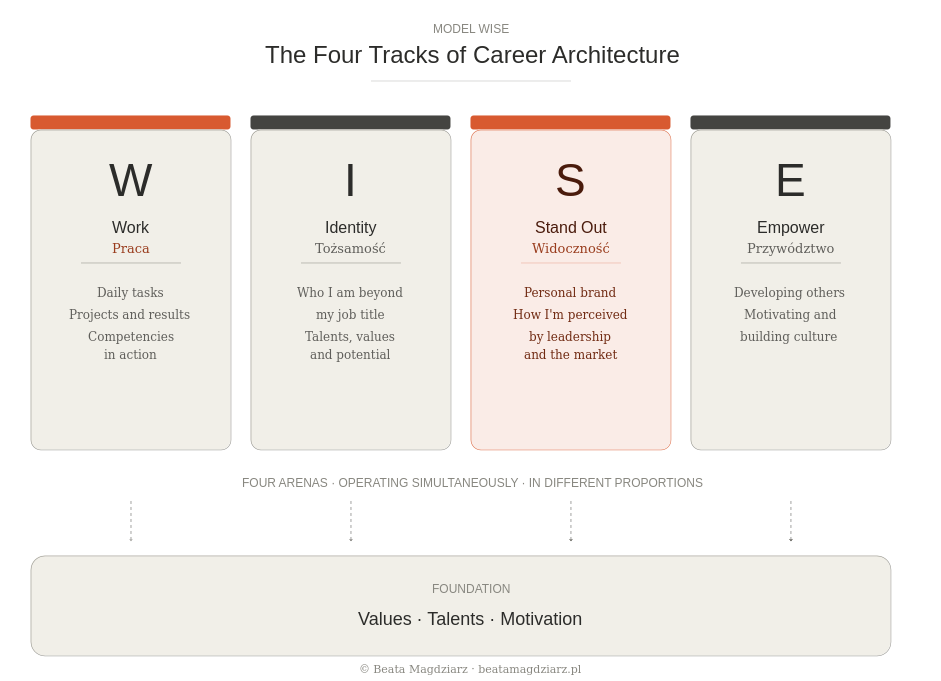
W — Work. My daily work: tasks, projects, results, responsibilities. This is where you build professional and soft competencies simultaneously, because every task is an exercise in thinking, every conversation with a manager is an exercise in communication, every team project is an exercise in collaboration. Most people focus exclusively on this track. That matters but without the others, it becomes a trap: you can be very busy and still be standing still.
I — Identity. Who am I professionally beyond my job description? What talents and values do I have that go beyond the scope of my responsibilities? What do I bring to the organisation as a person, not just as a role? This is the track on which you build professional self-awareness. Without it, it’s hard to manage your own development, because you don’t know where to start.
S — Stand Out. How am I perceived by my manager, by senior leadership, by the market? Am I engaged in initiatives that build my visibility, not through performance, but through the genuine value I give others? Even an introvert can be visible. This isn’t about being on stage. It’s about what you leave in people.
E — Empower. How do I motivate my team, how do I develop them, how do I support them? What is my role as a leader and is it clear to me, not just to my manager? This is the track for managers and leaders, though it’s worth observing earlier, because understanding how good leadership works is a competency in itself.
Many people have a plan for W. Few have a plan for I. Almost nobody treats S and E as strategic projects of their ow
Values and motivation are the foundation. The tracks are the map. The plan is the decision to connect the two and to start acting with intention.
What doesn't appear in your CV and decides everything.
You can have an excellent career strategy and feel completely depleted. That’s not a contradiction. It’s a signal.
There’s one condition without which the entire WISE architecture collapses: energy. You can have a plan and not have the strength to carry it. You can know what to do and not have the resources to begin. That’s why psychological resilience, recovery, and a growth-supporting environment aren’t add-ons to a career. They’re its infrastructure.
I see more and more tired people. Not lazy, not disengaged. Tired. Young people who are only just starting and already feel that something is wrong. Experienced people who achieved what they were aiming for and instead of satisfaction, feel a strange emptiness. This isn’t weakness. It’s a signal that something important got lost along the way.
Energy is built deliberately. Through regular rest and sleep, through conscious energy management rather than just time management, through knowing your own warning signals before the reserve runs dry, and through the ability to ask for help. But also through hobbies as a separate space where you exist without any agenda. Through sport and movement, which regulate thinking and stress resilience, not as discipline, but as hygiene. Through contact with nature, with the people close to you, with whatever stops you and restores perspective.
Values are the compass of that energy. When you know what genuinely matters to you like ecology, relationships, fairness, creativity, community, decisions come more easily. Harder choices become clearer. And it becomes easier to say no to things that aren’t yours. Awareness of your values is also a responsibility toward your environment. How we operate professionally affects the people around us.
Knowledge sharing is one of the most underappreciated forms of energy I know. And it drives me like almost nothing else. That’s precisely why I share my knowledge and practices here. I share because I want to. And because I know that knowledge released into the world always comes back somewhere. I hope you too will find inspiration and a tailwind through it. Sharing what you know, without expecting a return, is one of the most valuable practices for building meaning in your work. You learn faster, build relationships more deeply, and leave a trace that outlasts you.
WISE is a tool. But you decide the direction you take it and with what energy. Without energy, no strategy works.
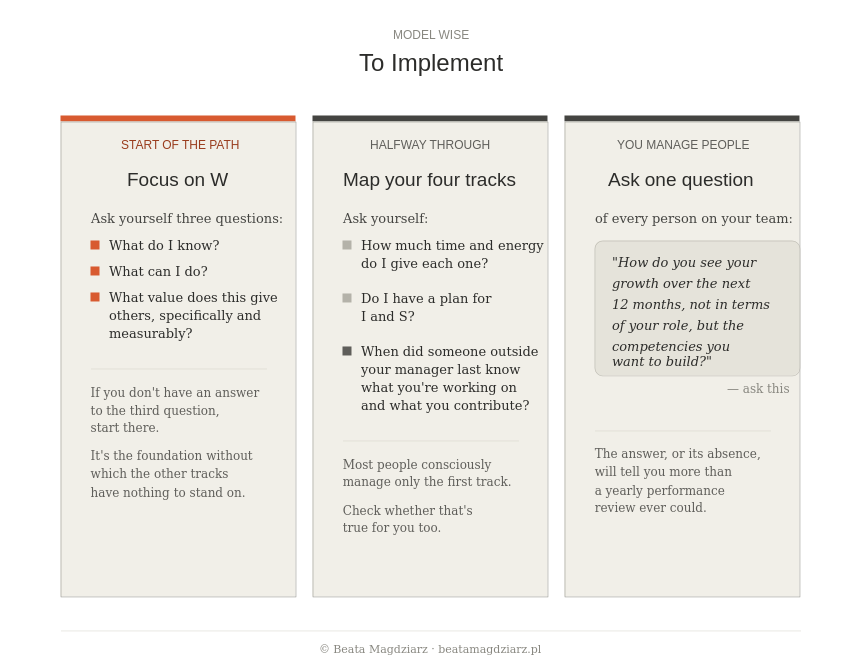
If you’re just starting your professional journey and one of your first job interviews is ahead of you, WISE is for you too. You may not yet have results, a personal brand, or a team. But you have W as a starting point: you’re building professional competencies and learning to communicate your value. That’s enough to start, consciously. In the next part of this series, I write about which competencies are essential on each track, and how to develop them at different career stages whether you’re at the beginning of your path, in the middle of it, or already managing a team.
In the end, it always comes down to decisions.
Over more than a decade of working with people at different career stages from a first internship to senior leadership. I notice one pattern that never stops surprising me.
Most people treat their professional development reactively. They react to job offers, to promotions, to crises. Rarely does someone sit down and say: „I have a plan for myself. I know which competencies I want to build this year, and why. I know what kind of environment I want to create around me. I know what trace I want to leave in this organisation.”
We have strategies for companies. For products. For campaigns. Rarely for ourselves.
And yet, the labour market is changing at a pace that, for the first time in history, outstrips the pace at which human beings change. Not because people are less capable than before. Because the change is faster, more complex, and demands active management — not passive adaptation.
Future competencies are not a trend topic. They’re a decision: do you want to design your career, or do you want to react to it?
This is the first article in the series „Future Competencies.” The next instalments cover: communication as the architecture of influence, strategic thinking in practice, and cognitive empathy as a professional advantage.
To implement
Additional Resources
To watch and explore:
- Leadership Lesson Big Think+ The 3 adjecitves that determine how far you go at work, Carla Harris (From Beata: an inspiring lesson on managing the gap between your own identity and external perception, the foundation of the Identity and Stand Out tracks in the WISE model)
- Simon Sinek, Leadership has to be learned (From Beata: In the Empower track, treat leadership as a craft that must be learned daily, placing empathy and active listening as the foundation for building independence and accountability in your team)
- Emma Grede, The Storytelling Formula that makes you infortgettable in Interviews, Aspire with Emma Grede (From Beata: I love Emma Grede, her content delivers practical tools for navigating every career stage, from first steps to the highest levels of leadership. My advice, inspired by her approach: In the Work and Stand Out tracks, stop being a „candidate with potential” and become a „solution provider” using the Context-Action-Result (CAR) structure to give your achievements measurable value in the eyes of an organisation)
- Jak Shetty Podcast, World Leading Psychologist ON Why You’re FAILING and Why Discomfort Will UNLOCK Success, Adam Grant (From Beata: I’m a fan of Jay’s podcasts, and Adam Grant is a particularly important voice here, he argues that growth isn’t a matter of innate talent, but a set of skills anyone can develop. In the Work and Stand Out tracks: stop asking for feedback about the past, and start seeking specific advice on what you can do better tomorrow. Actively seeking discomfort is development. A common mistake is waiting until you’ve „mastered” something before acting. Real learning happens when you use knowledge while acquiring it. And the highest level of that process is teaching others and knowledge sharing because explaining something to someone else helps you understand and retain it better)
- Mel Robbins: How to Communicate With Confidence & Ease (From Harvard Business School’s #1 Professor) (From Beata: the guest is Prof. Alison Wood Brooks, author of Talk, which I also recommend. She outlines the 4 pillars of communication: how to prepare, how to ask questions, how to attend to your conversation partner, and how to strengthen your message)
- Leadership Lesson Big Think+, Slow Productivity, Cal Newport (From Beata: Cal Newport’s concept of Slow Productivity is an excellent complement to the Work track, teaching how to escape the trap of „pseudo-productivity” and the illusion of busyness, in favour of a deep focus on quality)
Books worth reaching for:
- Adam Grant — Hidden Potential: The Science of Achieving Greater Things
- Cal Newport — Slow Productivity: The Lost Art of Accomplishment Without Burnout
- Carla A. Harris — Lead to Win: How to Be a Powerful, Impactful, Influential Leader in Any Environment
- Simon Sinek — Find Your Why: A Practical Guide for Discovering Purpose for You and Your Team
- Kazuo Ishiguro — Klara and the Sun ( From Beata: a beautiful novel about closeness, emotions, and artificial intelligence, raising ethical and social questions)
Academic and non-fiction sources:
- Peter Hollins — The Science of Rapid Skill Acquisition (2019) — on the methodology of fast competency acquisition and skill stacking
- Carol Dweck — Mindset: The New Psychology of Success (2006) — on growth mindset vs fixed mindset theory
- Anders Ericsson — Peak: Secrets from the New Science of Expertise (2016) — on the concept of deliberate practice
- Alison Wood Brooks — Talk: The Science of Conversation and the Art of Being Heard (2024) — on conversation architecture as a competency
- Adam Grant — Think Again: The Power of Knowing What You Don’t Know (2021) — on why willingness to change your thinking matters more than being right
- Cal Newport — So Good They Can’t Ignore You (2012) — on building career capital through mastery rather than following passion
- Daniel Kahneman — Thinking, Fast and Slow (2011) — on how we actually make decisions and where analytical thinking sits in practice
- Jim Rohn — American business philosopher, one of the most influential motivational speakers — cited in the context of environment mechanics and the influence of surroundings on development